ARTICLE:
The Knicks Won a Championship. Their Reward Is Salary Cap Hell.
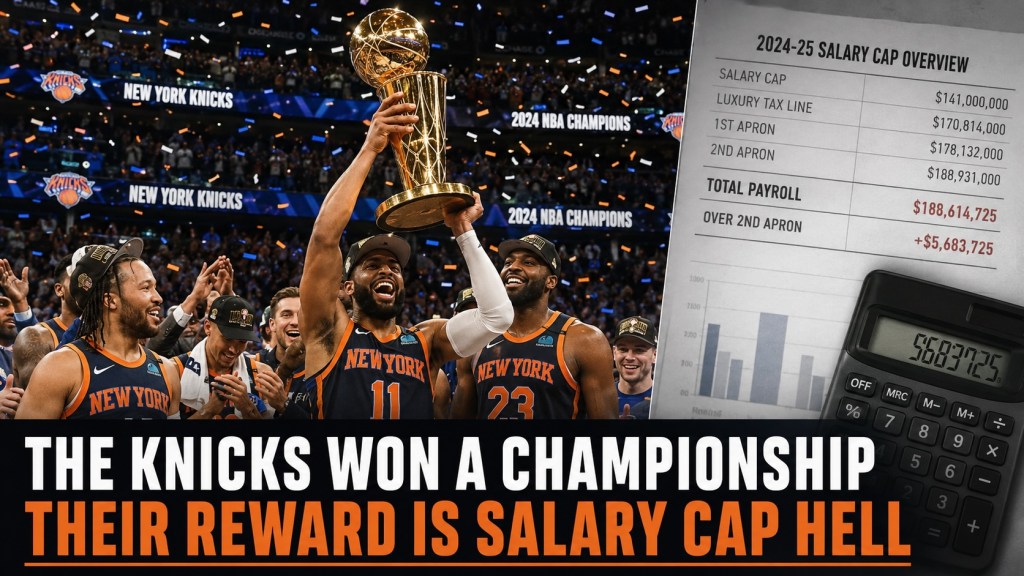
The New York Knicks finally did the impossible. They won the whole thing, gave Madison Square Garden the kind of title run that turns rational adults into people screaming into traffic cones on Seventh Avenue, and gave Knicks fans the one thing they have been demanding, predicting, hallucinating, and emotionally blackmailing the basketball gods over for more than five decades.
And now, after all of that, their reward is a spreadsheet with fangs.
Welcome to the new NBA, where winning a championship does not just make you a target. It makes you expensive. It makes every backup center, eighth man, and veteran guard part of a luxury tax crime scene. It turns the offseason from a celebration into an accounting exam, which is about the least romantic follow-up possible to a parade.
The Knicks are not dealing with the fun version of championship roster building. They are not sitting around asking, “How do we add one more star?” They are asking the much uglier question: “How much of the team that just won the title can we actually afford to keep?” That is where the second apron comes in.
If you are a normal person and not the kind of sicko who spends June reading collective bargaining agreement explainers, the second apron is basically the NBA’s new financial penalty box. Cross it, and team building becomes dramatically harder. You lose flexibility. You lose maneuverability. You get boxed in by restrictions on trades, signings, exceptions, and future roster moves. It is not just expensive. It is restrictive. That is the key distinction.
James Dolan has never really been accused of being cheap in the traditional sense. The Knicks have spent money. They have thrown money at bad ideas, medium ideas, and occasionally actual good ideas. Dolan refusing to cross the second apron is not necessarily about pocketing cash like a cartoon villain in an MSG luxury suite. It is about control.
Crossing the second apron means you are not just paying more. You are surrendering options. And for a Knicks team that just won a championship with a roster built on depth, toughness, matchup flexibility, and just enough chaos to make Tom Thibodeau look moderately rested by comparison, losing options matters. The problem is that staying under the second apron means someone has to go. Probably more than one someone.
Mitchell Robinson is the cleanest example and the most painful one. He is the longest-tenured Knick, the kind of player fans irrationally but understandably attach themselves to because he feels like part of the furniture. He has survived multiple versions of this franchise, some competent, some not so much. He rebounded, protected the rim, did dirty work, and gave the Knicks a physical presence that mattered. But sentiment does not protect you from cap math.
Robinson is an unrestricted free agent, and if another team wants to pay him real money, the Knicks may not have the room or the appetite to match it. That is a brutal reality after a championship run, but it is still the reality. You can love what Robinson gave this team and still admit that paying premium money for a backup center with offensive limitations and free throw issues gets complicated fast. That is especially true when Karl-Anthony Towns is already on the roster.
This is the part where fans get mad because they hear “backup center” and think it is disrespectful. It is not. Role matters. Salary matters. Playoff matchup value matters. Robinson can absolutely help a good team. He just might help another team at a price the Knicks cannot justify while trying to keep the rest of the operation intact. That is the cold, annoying, correct part.
Then there is Landry Shamet. He is the kind of player championship teams always need and then immediately struggle to keep. He is useful. He can shoot. He knows where to stand. He does not require the offense to bend around him. He had the kind of season that makes executives say, “We would love to have him back,” right before another team offers more than they want to pay. That is not betrayal. That is the market.
Role players on title teams get paid because other teams convince themselves they are buying winning habits. Sometimes they are. Sometimes they are buying the eighth-best player on a roster that was really driven by the first four. Either way, Shamet likely made himself more expensive by being exactly what the Knicks needed. Good for him. Bad for the budget.
Jordan Clarkson is the more interesting case because his value is not quite as simple. He is older, he has already made a ton of money, and he may not have the same market as a younger rotation piece. He also accepted a smaller role and, by all accounts, handled it professionally. That matters on a championship team. Not everyone who has spent years getting buckets can suddenly become a situational piece without turning into a locker room weather event.
Clarkson did, and that makes a return possible, especially if he likes New York and is willing to take a team-friendly number. But “possible” is doing a lot of work here. The Knicks are trying to fill out multiple roster spots with limited room, which means every dollar given to Clarkson is a dollar not available somewhere else.
This is how title teams die by a thousand little decisions. Not one catastrophic move. Not one awful contract. Not one shocking trade. Just a steady drip of “we can’t keep him,” “we need a cheaper version,” “we’ll replace that production internally,” and “the minimum market should have options.” That is how a championship roster becomes a slightly worse championship roster.
The Knicks’ front office deserves credit for building a team good enough to win it all. Leon Rose and company did not stumble into this. They assembled a group that fit. Jalen Brunson became the franchise anchor. Towns gave them star-level offensive gravity. OG Anunoby gave them defensive credibility and wing strength. Josh Hart did Josh Hart things, which is to say he played like someone forgot to tell him humans experience fatigue. Mikal Bridges brought two-way stability.
The Knicks were not just talented. They were coherent. That coherence is now the thing being threatened.
The stars are still there, which is the good news. Nobody is talking about tearing down the core. Nobody is floating some panic trade because the Knicks ran out of patience. This is not the old Knicks, where every offseason felt like someone might trade three first-rounders for a famous name and a knee brace. This is different. This is the new NBA punishing teams for being both good and expensive.
The Celtics learned it. The Nuggets learned it. The Suns have been living inside a financial escape room for years. The Warriors dynasty eventually became less about basketball genius and more about how many tax payments ownership could stomach before the roster started shedding parts. Now it is the Knicks’ turn.
The cruel part is that championship teams are supposed to be allowed to enjoy themselves for more than five minutes. Fans want the parade, the merch, the documentaries, the “run it back” quotes, the schedule release, the Christmas game speculation, the whole ridiculous championship ecosystem. Instead, Knicks fans get to debate apron space. That is disgusting behavior by the universe.
But it is also where the Knicks have to be disciplined. The worst thing they can do is confuse nostalgia with strategy. Keeping everyone sounds great until the bill arrives and the roster gets trapped. Letting the wrong players walk sounds responsible until an injury hits in February and suddenly the ninth man matters more than everyone thought. There is no clean answer. That is what makes this offseason fascinating.
If Robinson leaves, the Knicks need a real replacement. Not a name. Not a washed veteran who used to rebound in 2018. A real playable center who can survive playoff minutes behind Towns. If Shamet leaves, they need shooting and guard depth. If Clarkson leaves, they lose another ball handler and shot creator from the bench. If they keep one, they probably lose flexibility elsewhere. Every choice has a cost.
And that is before you even get to the bigger picture. Towns and Hart are extension eligible. Brunson’s team-friendly deal is one of the biggest reasons this whole thing works, but that does not make the rest of the roster cheap. Bridges and Anunoby are not exactly playing for coupons. A championship team with multiple high-level players is supposed to be expensive.
The question is not whether the Knicks should spend. The question is whether they should spend in a way that still lets them operate like a serious contender two years from now.
That is the line Dolan and the front office are trying to walk. Fans will call it cheap if Robinson leaves. They will call it reckless if the Knicks cross the second apron and get boxed in. They will call it genius if the cheaper replacements work. They will call it malpractice if they do not. That is sports ownership. Enjoy the parade, then immediately become a villain again.
The Knicks finally have something worth protecting. That is the real shift. For decades, the franchise was trying to buy credibility, fake relevance, or skip steps. Now they are defending an actual championship team with actual championship problems. That is better. It is also harder.
The Knicks won a title, and the basketball part finally made sense. Now comes the part where the cap sheet tries to punch a hole through the confetti. Welcome to being champions. It turns out the hangover comes itemized.


 ktomp_ny
Leave a comment