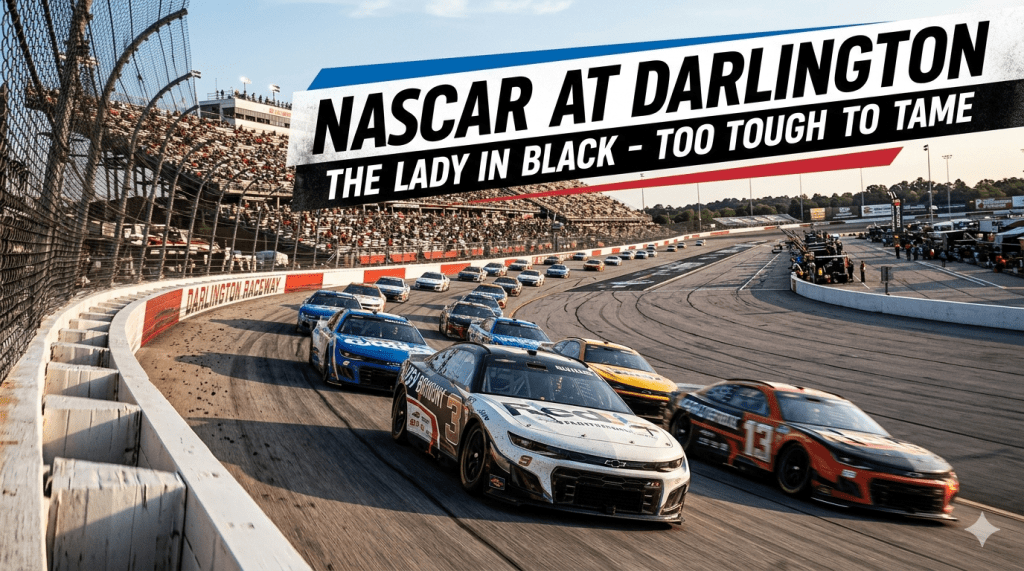
Darlington’s New Package Might Turn Sunday Into the Most Unpredictable Race of 2026
If you’ve been waiting for NASCAR to stop being predictable, Sunday at Darlington Raceway might be your moment. The Goodyear 400 marks the first time the Cup Series runs the new short track package at “The Lady in Black,” and the early feedback from drivers ranges from cautious optimism to outright fear. This isn’t your typical Darlington race. This is 750 horsepower, minimal downforce, and tire falloff that could hit four seconds or more per run on a track that hasn’t been repaved since 2008. Translation: complete chaos is on the table.
For context, NASCAR bumped horsepower from 670 to 750 this season and stripped away aerodynamic stability by cutting the rear spoiler to three inches and simplifying the diffuser. The package already showed its teeth at Phoenix two weeks ago, where tire wear spiked and passing opportunities opened up throughout Ryan Blaney’s win. But Phoenix is a flat, predictable mile oval. Darlington is an egg shaped, 1.366 mile layout with 25 degrees of banking in turns one and two, 23 degrees in three and four, and an abrasive surface that eats tires for breakfast even without the extra horsepower. Now you’re adding 80 more horses and taking away the underbody components that keep these cars stable. The result is a recipe for survival rather than speed.
Denny Hamlin put it bluntly on his Actions Detrimental podcast a few weeks back. “These cars with essentially little to no underbody are absolutely out of control,” Hamlin said. “I’m predicting four seconds of falloff. It might be more. Even on new tires, just absolutely out of control. So it’s going to be a wild card race.” Brad Keselowski echoed that concern, noting that going 50 laps on a set of tires was nearly impossible with the Next Gen car in recent seasons. With more power and less grip, that number could drop even further. Teams get 10 sets of tires for the race, meaning pit strategy becomes a guessing game between staying out long to gain track position and pitting early to avoid getting swallowed up by cars on fresh rubber.
Chase Briscoe called it potentially the hardest test of the season. Ricky Stenhouse Jr. said it will come down to how much falloff actually materializes and whether drivers stay disciplined enough to avoid the kind of mistakes that pile up quickly at Darlington. Christopher Bell said fans might witness a completely different style of racing compared to previous Next Gen events at the track. The consensus is clear: nobody really knows what Sunday will look like until the green flag drops.
So who has the best shot at surviving Sunday? The usual Darlington suspects are in play, led by Denny Hamlin. He won this race in 2025 and has finished no worse than seventh in the last four Darlington starts. With five career wins at the track, Hamlin knows how to manage tires better than almost anyone in the field. If the falloff hits four seconds like he’s predicting, the drivers who can nurse a set of tires through an extra five or ten laps without losing significant time are going to control the race late.
Tyler Reddick leads the points standings after three wins to start 2026, and his Darlington resume in the Gen 7 era is exceptional. Eight starts, 9.6 average finish, 320 laps led, and six top 10s including four runner up finishes. That consistency shows an ability to adapt to changing conditions and maximize the car he has, which is exactly what tire management racing rewards.
Kyle Larson is the wild card. He hasn’t won a Cup Series race yet this season, but he’s a former Darlington winner who has led hundreds of laps there over the years. The problem is that Larson swings between dominant and disastrous at this track. When he’s on, he’s unstoppable. When the setup is off or he pushes too hard, he spins early and the day is over. With the new package amplifying every mistake, Larson’s day could go either direction.
Chase Briscoe won last September’s Southern 500 in dominant fashion, leading 309 of 367 laps. His recent comments suggest he’s prepared for the difficulty of this package, and drivers who know what they’re walking into tend to adjust faster than those who get surprised. William Byron has unfinished business after dominating last year’s race only to fall apart late and finish second. If the Chevrolets can find speed under this package, Byron has the talent to close the deal.
Don’t sleep on the veterans. Brad Keselowski won the Goodyear 400 back in May 2024 and knows how to win here. His experience managing old tires could be a significant advantage if the falloff is as severe as predicted. Bubba Wallace has five top 10s in his last seven Darlington starts and has been no worse than 11th in the first five races of 2026. Chris Buescher has three straight top 10s at Darlington and his crew chief is widely regarded as one of the best tire management strategists in the garage.
The wild card in all of this is the weather. Sunday’s forecast calls for hot and sunny conditions, which will only accelerate tire degradation. Goodyear is bringing a left side tire that was used at Darlington last season and a right side tire that debuted at Kansas in September. That asymmetry could make the car feel inconsistent over long runs, especially as one side loses grip faster than the other. Teams that can balance the setup to account for that imbalance will have a significant edge.
Strategy will make or break this race. With only 10 sets of tires available and potential four second falloff, crew chiefs face a math problem with no clean answer. Do you pit aggressively to stay on fresher rubber and risk running out of sets late? Do you stretch runs long to gain track position and hope the tires hold up? Do you gamble on caution timing and hope a yellow flag bails you out before degradation destroys your day? Every decision compounds because Darlington punishes drivers who push too hard. One mistake in turn three trying to make up time on worn tires turns into a trip to the wall and a destroyed race car.
The beauty of this race is that it rewards old school NASCAR qualities. Driver skill matters more than aerodynamic advantage. Tire management beats raw horsepower. Veteran racecraft trumps qualifying speed. The drivers with Darlington history and a proven ability to manage equipment over long runs have the edge, but in a race this unpredictable, Sunday could belong to anyone who figures out the new package first.
Sunday at Darlington is going to test every assumption about how these cars race under the new package. Tire management will matter more than raw speed. Crew chiefs will matter as much as drivers. And the track that has always been too tough to tame just got significantly tougher. If you’ve been waiting for NASCAR to deliver unpredictability, chaos, and a race where strategy actually determines the outcome, you’re about to get your wish. Just don’t be surprised if half the field is complaining about the handling and the other half is sliding into the wall.
The green flag drops Sunday at 3:00 PM ET on FS1.


 ktomp_ny
Leave a comment